Dr. Suzanne Simpson:
Have you ever watched your teen struggle and felt every part of you wanted to step in and fix it?
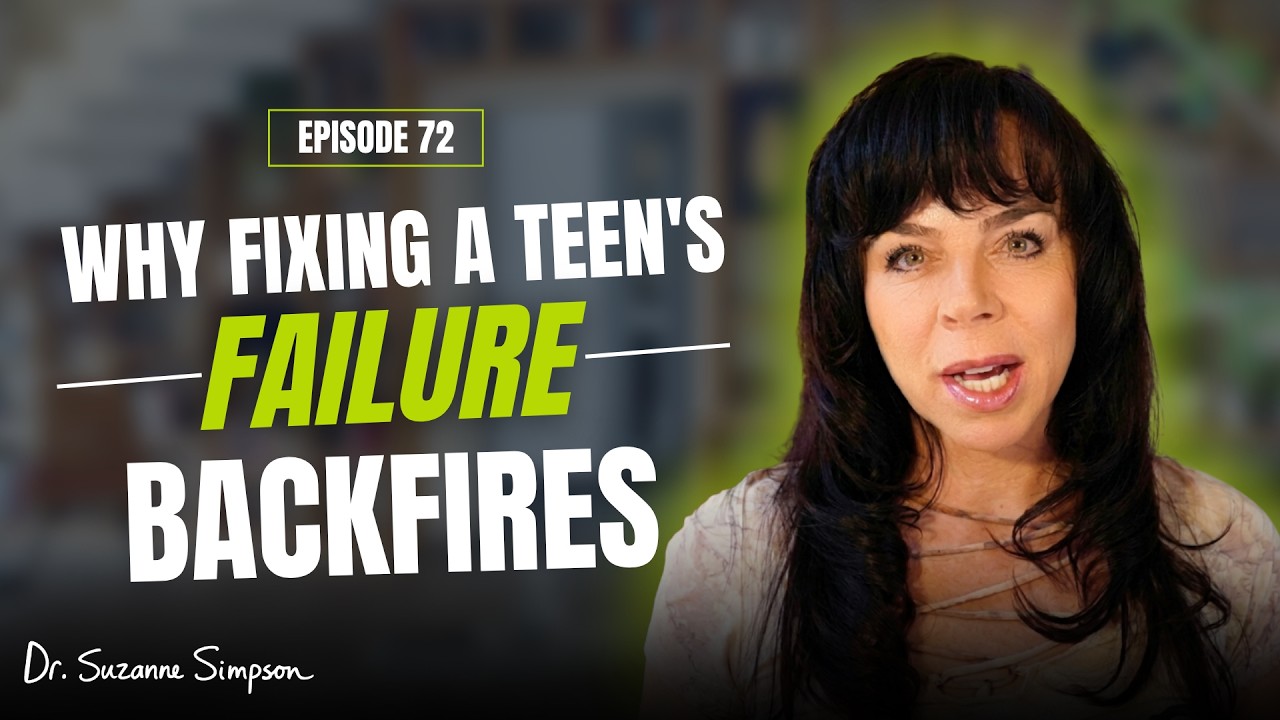
I’m going to share the three things that parents do when their teenagers fail that actually make things worse,
and I’m going to give you the better response for each one. Stay with me to the end, because then I’m going
to leave you with one question, just one, that completely changes how you can better manage your child’s
struggles.
Let me start with a story. I had a friend whose son was struggling in a high level math class. The teacher
called her and suggested bumping him down to an easier course just so he’d get a passing grade. My friend
was torn. Our natural instinct is to pick up the pieces before they even hit the ground.
I asked her one question: is he capable? Can he do the math? She said yes, he is. He just wasn’t doing the
work or putting the time in. So I said, let him fail. I advised her to go to that teacher and ask that her son get
the grade he actually earned.
My friend did it. And guess what? Her son failed the math. They had to cancel their summer travels and he
stayed home to redo the math in summer school. He never had math issues again. He learned that in the
real world, if you have a job and you don’t show up or you don’t do the work, you get fired. By allowing that
failure, my friend gave him the most important skill for his future. It’s called self-efficacy, the ability to know
that you can do it.
Behaviour is information about an internal experience. When we see a failing grade, we tend to see a bad
student or a lazy kid, but in reality, a failing grade can be a signal. When we rush in to save our kids, we are
essentially turning off the smoke detector before we have even found the fire.
When your child fails, don’t move to a solution immediately. Stop and ask what this behaviour is actually
telling you. My research found that students have a deep heart desire to succeed. They want to flourish,
and if they tell you they don’t care about school, I guarantee they are lying. The students told me that true
success is found through two things: completing something, and understanding something. When you go try
to fix that grade, you rob them of the real success, the knowledge that they succeeded, and that is what
actually builds their self-worth. You are taking a brick out of the foundation of their confidence when we just
go in and save the day.
Here’s the first thing parents do that backfires. Number one, we solve the problem instead of reading the
signal. The better response is to pause and ask what the behaviour is telling you before you do anything
else. What is my child saying here? If you are panicking about their future, you are no longer on their turf.
You are on the turf of your own fear.
Here’s number two. We try to connect while we are still dysregulated. We’re watching them fail, they’re
doing something wrong, and then we respond dysregulated. The better response is to regulate yourself first,
even though it’s frustrating watching a child fail, literally fail, making mistakes, doing things we don’t agree
with. We must be regulated. Take the moment, tell them you need a second, then go back in.
Consider the research of Jonathan Haidt on The Anxious Generation. He argues that children need
challenge and stress to become antifragile, so they build strength. If we don’t let our kids wobble, they never
learn how to stand. We think we’re protecting them, but shielding them from discomfort actually reinforces
the belief that they can’t handle hard things.
I found students who were perfect in elementary school, quiet and studious and engaged, but at the
psychiatric unit I taught at, they revealed they were masters of masking. They did everything possible to
hide the horror of their home lives just to appear normal. Many of our kids are doing this today, especially in
high pressure cultures where the pressure to perform is crushing, and they put on a facade while they are
drowning in shame. Shame is the intensely painful belief, I am a mistake, versus, I made a mistake.
When we fix the failure for them, we are often validating their shame. We’re saying, you couldn’t have
handled that. But when we let them fail and stay with them, we provide the empathy that is the direct
antidote to shame.
As parents, we can learn this. We often have an agenda of good grades or elite universities. We are so
focused on the byproduct, that grade, that we miss the kid. We need to trade this for an agenda of
wholeness for our kids. So stop asking what’s wrong. It puts the burden on them before they are ready.
Instead, get eye to eye and ask, what’s going on? It’s a casual, non-threatening thing to do. It puts them in
control of the conversation, which is exactly what they need when they feel like they’ve lost control through
failure.
That brings me to number three. We come in with an agenda instead of a question. The better response is
to lose your agenda, sit with them, ask what’s up, and let them lead.
I’ve had so many parents tell me, Suzanne, my kid needs to learn grit, I can’t just be soft. Madeline Levine
argues that overparenting actually blocks competence. Grit and resilience aren’t built in a vacuum. You can’t
ask a kid to get back up if they don’t have a secure base to push off from, and securely attached
relationships are what provide that base. When you allow a child to fail, you aren’t being soft, you are being
a champion. You are saying, I believe you are capable of handling the consequences, and I’m going to sit
with you in this mess until you find your way back.
I found that what kids actually need is ultimately support, understanding, and care. They want us to pursue
them. They don’t want to have to come to us, they wait to see if we’ll come to them. Pursuit means taking
the initiative to check in even when they push you away. It means noticing when their affect, their
disposition, their body language shifts. It’s okay to tell your kids, I am frustrated right now, I need a second
to calm down, and then go back. That models the exact regulation they need to learn from their own
failures.
We have this idea that meeting a child’s social and emotional needs means we’ve failed as a parent
because we aren’t focusing on the standards. But many teens in my study suggested that if those needs
aren’t met, the education has failed, because you cannot learn if you don’t feel safe, and you cannot
succeed if you don’t feel supported.
Now here’s what I promised you at the start, the one question that changes everything about how you see
your child’s struggles and allowing them to fail. Most parents ask, how do I protect my child from this? But
here’s the question that actually builds resilience: what does my child need to learn from this, in this moment
of their failure? What do they need to know as an adult from this?
So we don’t fix, and we can’t avoid, but we can learn. The research shows that kids who are shielded from
failure don’t just stay the same, they become more fragile over time. Your child needs to fail with you beside
them, not in spite of you hovering above them.
My friend’s son, who failed that math class, didn’t just learn math in summer school. He never had problems
in math again, but he learned that his mother was someone he could trust with his life when it got messy.
He learned that he could survive a catastrophe and come out the other side stronger. He learned that his
value wasn’t a letter on a report card, but his ability to show up and try again.
Remember, you can’t influence a person you don’t connect with. You cannot teach grit to a child who feels
invisible. You cannot build resilience in a kid you are too afraid to let struggle.
So get on their turf, let them fail, stay regulated yourself, and provide the support, understanding, and care
that they are screaming for through their silence. When you do that, you aren’t just helping them pass a
class. You are building a young person who can show up for themselves in the world. Everything else
follows.
I am Dr. Suzanne Simpson, and follow me for more ways to get on your kids’ turf. You can click like and
subscribe to this channel for way more videos to come.